8 Best Leonardo da Vinci Coffee Table Books (2026)
Eight Leonardo da Vinci coffee table books, reviewed — from Taschen's eighteen-pound XXL monograph to the Windsor drawings, a facsimile of the notebook Bill Gates owns, and the four-volume set that took twenty-five years to write. Here's exactly who each book is for.
Leonardo is the hardest artist in the world to buy a book about, and the reason is counterintuitive: he barely painted. Fewer than twenty surviving paintings are widely accepted as his, which means no publisher can fill four hundred pages with his canvases the way they can with Monet or Van Gogh. What they fill the pages with instead is everything else — the drawings, the notebooks, the anatomy, the machines. So the real question isn't which Leonardo book is best. It's which Leonardo you actually want on your table.
There's the painter, whose surface you want reproduced large enough to read the brushwork. There's the draughtsman, whose red chalk and silverpoint are a completely different aesthetic experience from the paintings. And there's the mind — the mirror-written notebooks, the dissections, the water studies — which is arguably the most visually distinctive thing he left behind and the part most general art books skip.
The eight books below cover all three, at every price from twenty-five dollars to five hundred and fifty. I've also included the one thing no other roundup on this subject bothers to sort out: which Taschen Leonardo is which, because there are four of them with nearly identical titles and people buy the wrong one constantly.
Disclosure: This article contains affiliate links. If you purchase through these links, I earn a small commission at no extra cost to you.
My Top 3 Picks at a Glance
- Best Overall: Leonardo. The Complete Paintings and Drawings (Taschen XXL) — 712 pages, eighteen pounds, every painting plus nearly 700 drawings, at a scale that shows brushstrokes
- Best for Drawings: Leonardo da Vinci: A Life in Drawing — 200 sheets from Windsor, the most important Leonardo drawings collection in the world
- Best Value: Leonardo's Notebooks — the mirror-written mind, sorted by subject, in a large-format volume that costs less than a nice dinner
1. Leonardo. The Complete Paintings and Drawings — Frank Zöllner & Johannes Nathan
| Authors | Frank Zöllner, Johannes Nathan |
| Publisher | Taschen (XXL) |
| Pages | 712 |
| Dimensions | 11.4 x 15.6 inches |
| Weight | 18.06 lbs |
| Coverage | All known paintings, catalogue raisonné, and nearly 700 drawings |
| Best For | Best overall — the definitive Leonardo, statement-piece scale, serious art book collectors |
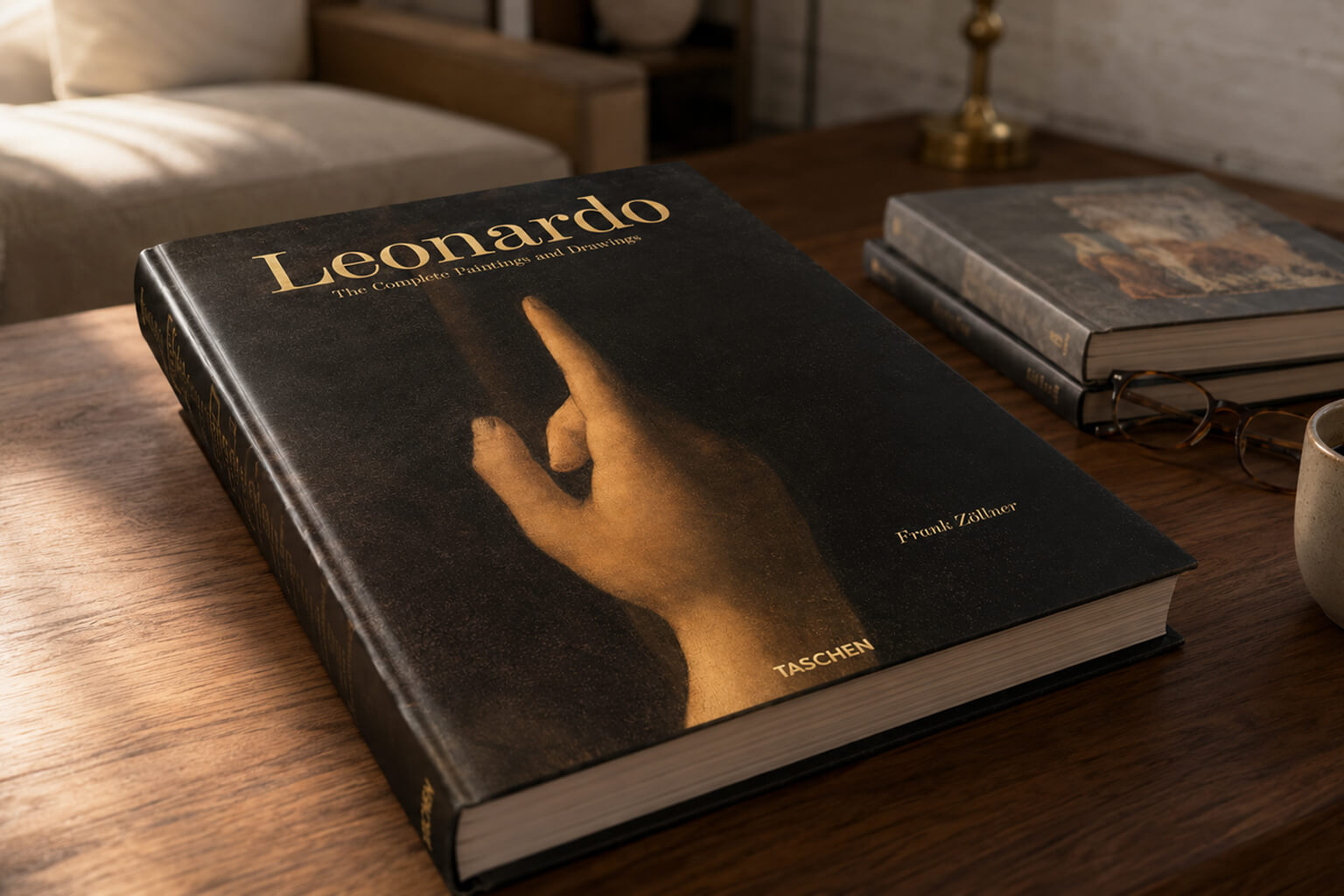
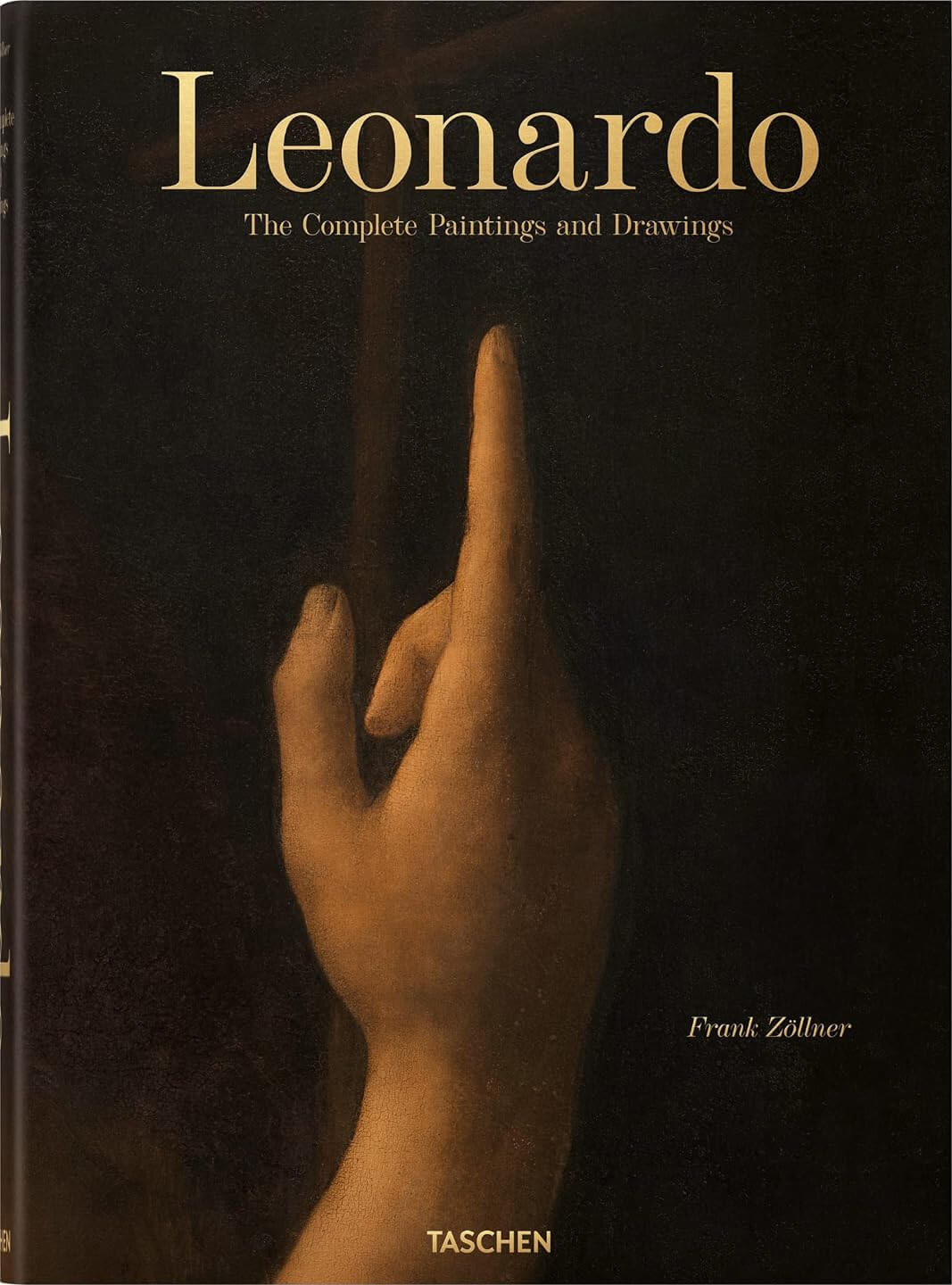
Frank Zöllner has spent his career on this subject — he wrote his postdoctoral treatise on motion and expression in Leonardo's art, and he has been Professor of Medieval and Modern Art at the University of Leipzig since 1996. Johannes Nathan earned his doctorate at the Courtauld with a dissertation on Leonardo's working methods. Between them they produced what is, by any reasonable measure, the most comprehensive Leonardo survey in print: 712 pages at 11.4 by 15.6 inches, weighing just over eighteen pounds, presenting all the paintings alongside nearly 700 drawings.
What the format buys you is detail. The book's whole argument is full-bleed enlargement — brushwork reproduced at a scale where you can follow individual strokes across a page, which is the one thing a museum visit can't give you, because the Louvre keeps you nine feet back behind glass. The structure is two-part: ten chapters tracing the life and work through letters, contracts and diary entries, then a catalogue raisonné covering every surviving and lost painting with notes on condition. For the current edition Zöllner added a new preface addressing recent scholarship, including a critical look at the Salvator Mundi that sold at auction for roughly €400 million, and a number of illustrations were replaced with new photography.
What I keep returning to: The Annunciation and the Last Supper get double-page spreads, and it's the Annunciation that rewards it more. At this scale the angel's wing reads as feathers rather than a shape, and the strange, slightly-wrong perspective of the sarcophagus — the thing Leonardo scholars have argued about for a century — becomes something you can see rather than something you have to be told about.
The honest downside: Eighteen pounds is not a figure of speech. This book does not sit on a delicate console table, it does not travel between rooms, and turning pages requires a genuine surface. At $200 it's also the most expensive single-volume book here, and if what you love about Leonardo is the notebooks and the machines rather than the paintings, you're paying for a lot of catalogue apparatus you won't use.
The bottom line: The reference edition and the statement piece in one object. If you own one Leonardo book for the rest of your life, this is the one — provided you have the table to put it on.
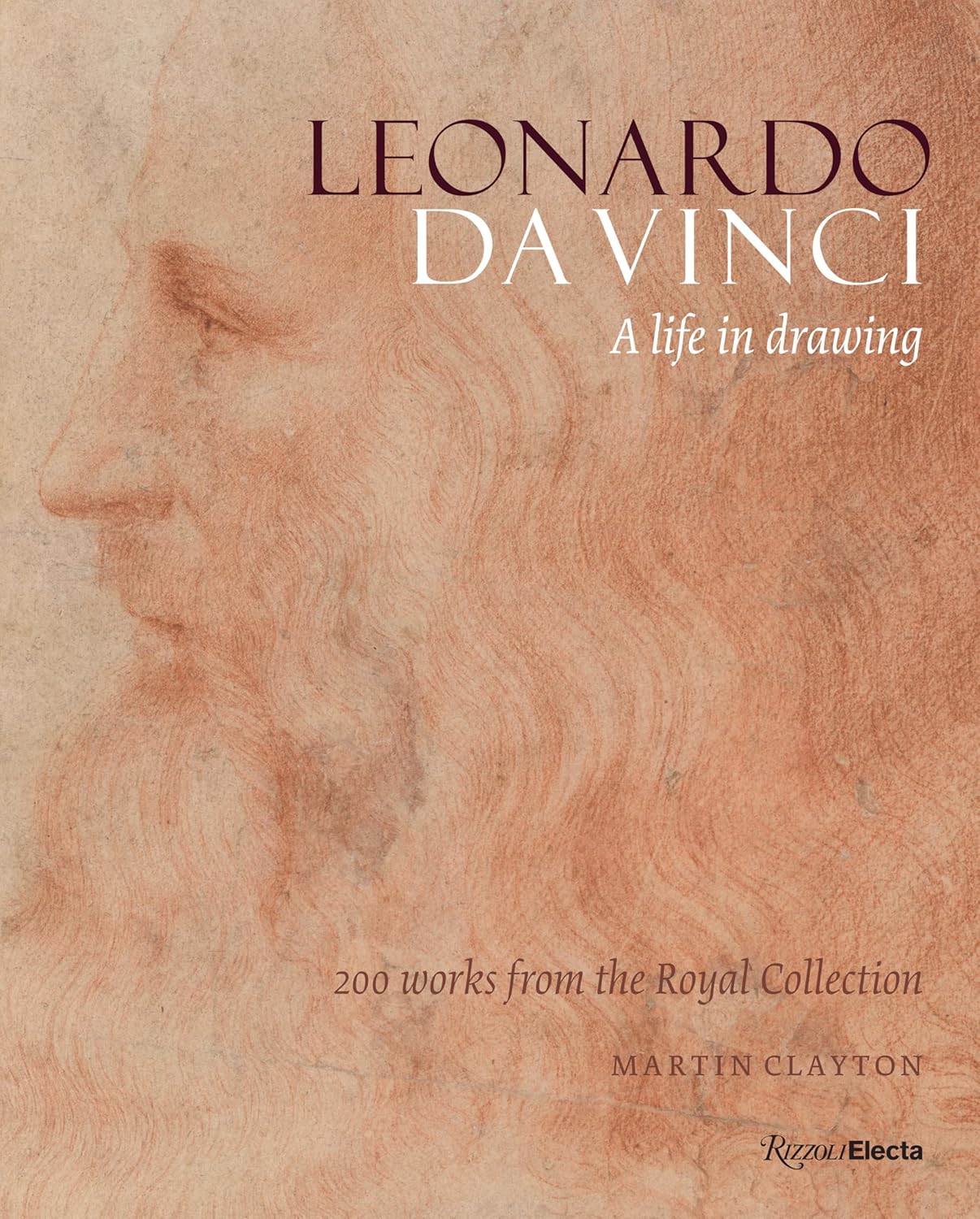
2. Leonardo da Vinci: A Life in Drawing — Martin Clayton
| Author | Martin Clayton |
| Publisher | Royal Collection Trust (US edition: Universe / Rizzoli) |
| Pages | 256 |
| Dimensions | ~10.25 x 8.25 inches |
| Coverage | 200 drawings — anatomy, botany, maps, engineering, portrait studies |
| Best For | Drawing lovers, anyone who finds the notebooks more interesting than the paintings |
Martin Clayton is Head of Prints and Drawings at Royal Collection Trust, which means he looks after the single most important collection of Leonardo drawings in existence — the Windsor sheets, held there since the seventeenth century. This book gathers the 200 drawings that were shown across twelve simultaneous UK exhibitions in 2019 for the 500th anniversary of Leonardo's death, and it is the best single-volume introduction to Leonardo as a draughtsman that exists at a normal price.
The range is the point. Maps and botanical sketches sit alongside anatomical studies, drawings of faces, and engineering designs — and seeing them sequenced rather than sorted by discipline makes an argument the paintings can't. Leonardo did not think of these as separate activities. A study of water turbulence and a study of curling hair appear on facing pages and they are recognisably the same investigation. Clayton's commentary is short, specific and never padded; he tells you what you're looking at, when it was made and why it matters, and then he gets out of the way.
What I keep returning to: The late deluge drawings. Black chalk, almost abstract, made when Leonardo was in his sixties and had essentially stopped painting — spirals of collapsing water and rock that look like nothing else made before the twentieth century. In the paintings he is a Renaissance master. Here he looks like a man drawing something he has seen in a dream.
The honest downside: At roughly 10 by 8 inches this is a normal-sized book, not a display object, and several of the Windsor sheets are dense enough that they'd genuinely benefit from a larger reproduction. Be careful when ordering: the title exists under several ISBNs across Royal Collection Trust, Universe and Rizzoli imprints, in both hardcover and paperback, and stock rotates between them.
The bottom line: The best value-for-quality book on this list. If the Taschen XXL is out of budget or out of scale for your home, this is the Leonardo book to buy instead.
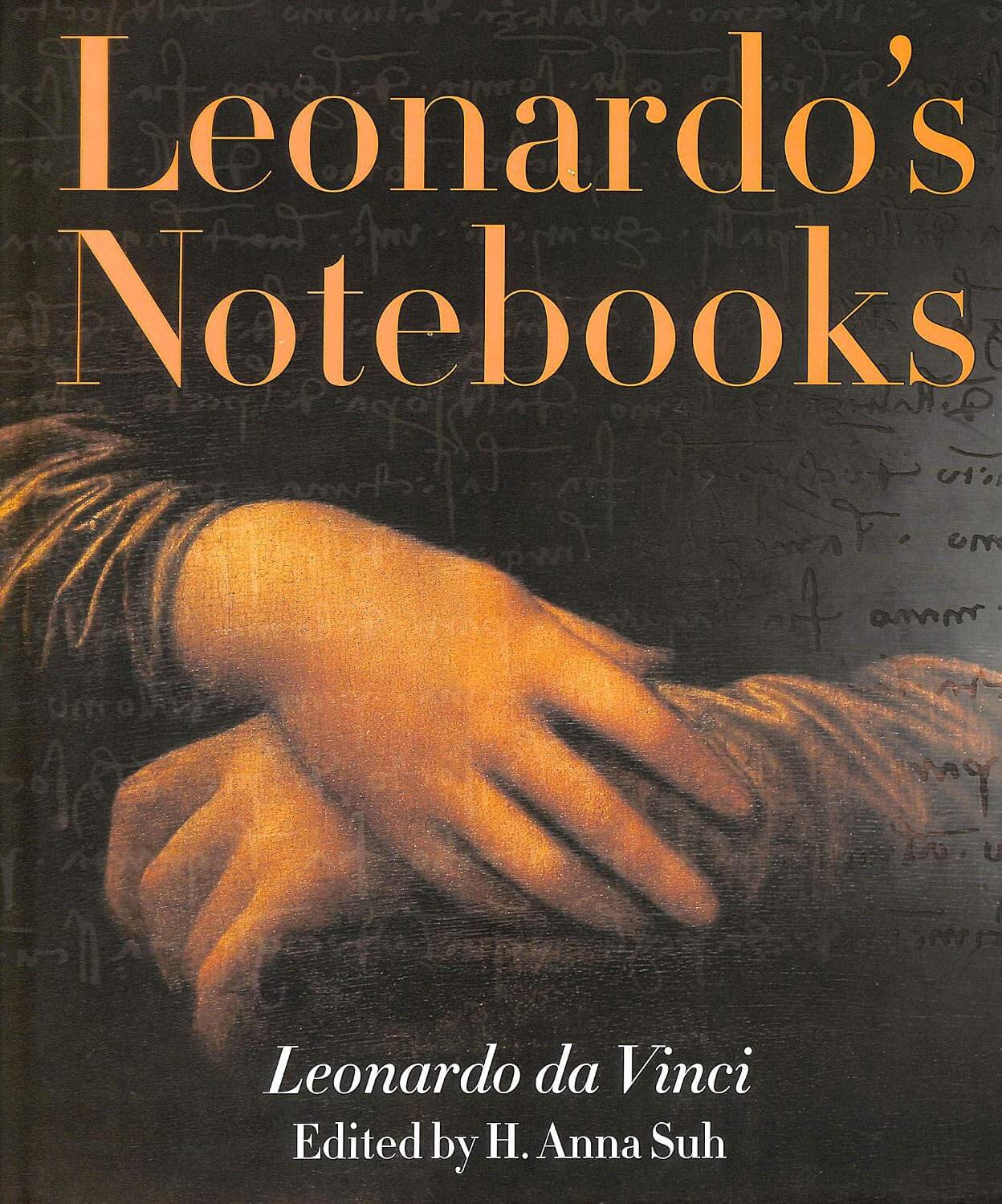
3. Leonardo's Notebooks: Writing and Art of the Great Master — edited by H. Anna Suh
| Editor | H. Anna Suh |
| Publisher | Black Dog & Leventhal |
| Pages | ~334 (2005 hardcover); expanded 2013 edition also available |
| Dimensions | ~12.25 x 10.75 inches |
| Coverage | Notebook writings and drawings by subject — anatomy, botany, optics, architecture, machines |
| Best For | Best value; readers who want Leonardo's mind rather than his masterpieces |
H. Anna Suh has a master's in art and archaeology from Princeton and served on the curatorial staff of the Metropolitan Museum of Art, and the editorial decision she made here is the reason this book works. Rather than reproducing the notebooks in their original chaotic order, she sorts Leonardo's writings and drawings into subjects — human figures, light and shade, perspective and visual perception, anatomy, botany and landscape, geography, the physical sciences and astronomy, architecture, sculpture and inventions — and keys nearly every passage of writing to the drawing it describes.
That sounds like a small thing. It isn't. Leonardo's actual notebooks are a nightmare of interleaved subjects: a shopping list, a joke, a gear mechanism and a study of a swallow's wing on one sheet. Scholars need that disorder preserved. Everyone else needs what Suh did, which is to make the material navigable while keeping the text and image together, so that when Leonardo writes about how a bird recovers from a stall you are looking at the drawing he made while thinking it. At around 12 by 10 inches it's a genuine large-format book, and it sits in the price band where you can buy it without deliberating.
What I keep returning to: The water studies. Pages of vortices behind an obstacle, drawn over and over with slight variations, alongside notes trying to work out the rule. He never got the rule. But the drawings are the closest thing in art history to watching someone think in real time, and they're the reason the Codex Leicester facsimile further down this list exists as a separate entry.
The honest downside: The reproductions are working reproductions, not the museum-grade plates you get from Taschen or Royal Collection Trust — this is a $30 book and it looks like one on close inspection. There are also several editions in circulation (2005 hardcover, 2013 expanded, various paperback and flexibound printings) with different page counts, so check which one a listing is actually selling.
The bottom line: The best introduction to Leonardo's notebooks in print, and the single best value on this list. If you're buying one book for someone who likes ideas more than art history, buy this one.
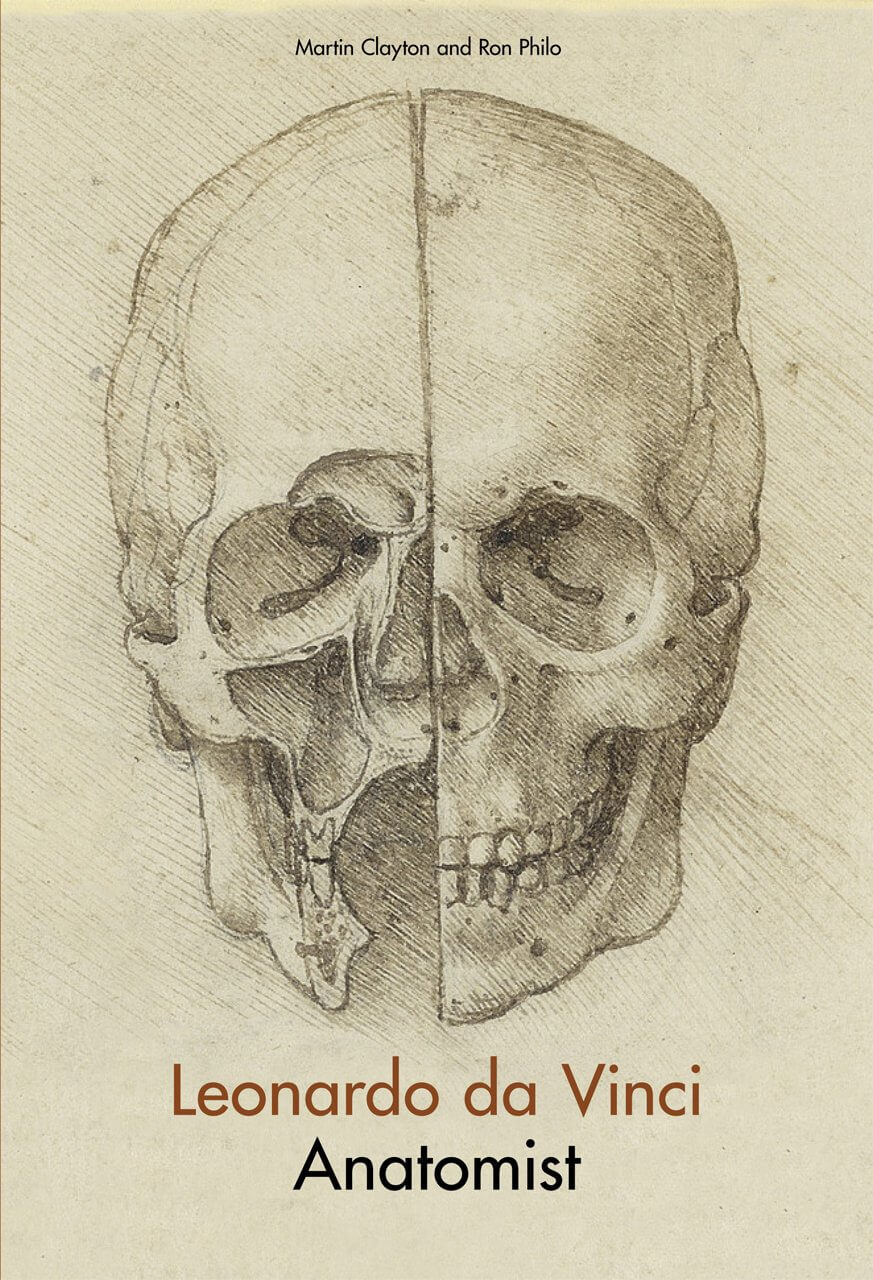
4. Leonardo da Vinci: Anatomist — Martin Clayton & Ron Philo
| Authors | Martin Clayton, Ron Philo |
| Publisher | Royal Collection Trust |
| Pages | 256 |
| Dimensions | ~10 x 8 inches |
| Coverage | 90 anatomical studies from the Windsor collection |
| Best For | The single best deep dive; doctors, medical students, science-minded readers |
Leonardo dissected more than thirty human cadavers, and the drawings he made from them sat essentially unknown until around 1900. That's the fact that makes this book what it is: these are among the finest anatomical illustrations ever produced, and they had no influence on the history of medicine whatsoever, because nobody saw them. Leonardo intended to publish an anatomical treatise and recorded his findings across more than a thousand notebook pages, but the work was never completed, and Windsor has held the surviving studies since the seventeenth century.
Clayton handles the art history, Ron Philo — adjunct associate professor at the University of Texas Health Science Center at San Antonio — handles the anatomy, and the collaboration is what elevates this above a picture book. Philo tells you which of Leonardo's observations were correct, which were wrong, and which were four hundred years early. The Boston Globe noted that the ninety studies collected here made it the largest published collection of the anatomical drawings to that date. The heart studies in particular are extraordinary — he worked out the function of the aortic valve using a glass model and grass seeds in water, and the drawing of that experiment is in this book.
What I keep returning to: The sheet of the foetus in the womb. It's the most reproduced anatomical drawing ever made and it is genuinely strange in context: the foetus is observed with total accuracy, and the uterus around it is wrong, borrowed from a cow, because he had never dissected a pregnant woman. Both things on one sheet. That's the whole story of Leonardo's science in a single image.
The honest downside: Availability is the real problem. The Royal Collection Trust printings go in and out of stock and the hardcover often trades above list price, so you may end up in the secondhand market. It's also genuinely specialised — if you want Leonardo the painter, this book will not scratch that itch at all.
The bottom line: The best subject-specific Leonardo book in print, and the one that most changes how you think about him. Buy it when you find it in stock.
5. Leonardo da Vinci's Codex Leicester: A New Edition, Volume I — The Codex
| Editors | Domenico Laurenza, Martin Kemp |
| Publisher | Oxford University Press |
| Pages | 88 |
| Dimensions | 348 x 249 mm (~13.7 x 9.8 inches) |
| Coverage | Full facsimile of the 72-page Codex Leicester |
| Best For | The most unusual object here; anyone drawn to Leonardo the scientist |
The Codex Leicester is the only Leonardo notebook in private hands. It runs to 72 pages, written in Italian in Leonardo's characteristic mirror script and supported throughout by drawings and diagrams; it's named for Thomas Coke, later Earl of Leicester, who bought it in 1719, and it held the record for the most expensive book ever sold when Bill Gates purchased it in 1994. Volume I of Oxford's four-volume scholarly edition is the facsimile on its own — 88 pages, published in 2019 at $32.95 — and it's an oddly perfect coffee table object, because you cannot read it and that turns out not to matter.
The subject is water. Leonardo circling the same problem for a hundred pages: how water moves, why rivers erode the banks they erode, what makes a whirlpool hold its shape, why there are marine fossils in mountains. The pages are dense mosaics of mirror writing broken by small precise diagrams, and at nearly fourteen inches tall the facsimile reproduces them at close to the scale of thought. Guests pick it up because it looks like an artefact rather than a book, and then spend ten minutes trying to read a single reversed line.
What I keep returning to: The fossil argument. Leonardo reasoned his way to the conclusion that seashells found high in the Apennines had not been carried there by the biblical flood but deposited when those mountains were seabed — an essentially modern geological argument, written in a private notebook in the early 1500s, addressed to nobody.
The honest downside: Volume I is the facsimile and nothing else. There is no translation, no transcription and no commentary in this volume — those live in Volumes II, III and IV, each of which costs around $130. Several reviewers have bought Volume I expecting a readable edition and been annoyed. It also drifts in and out of print, so stock is unpredictable.
The bottom line: The most conversation-starting object on this list, and remarkably affordable for what it is. Buy it as an artefact, not as a reading edition.
6. Leonardo da Vinci: The 100 Milestones — Martin Kemp
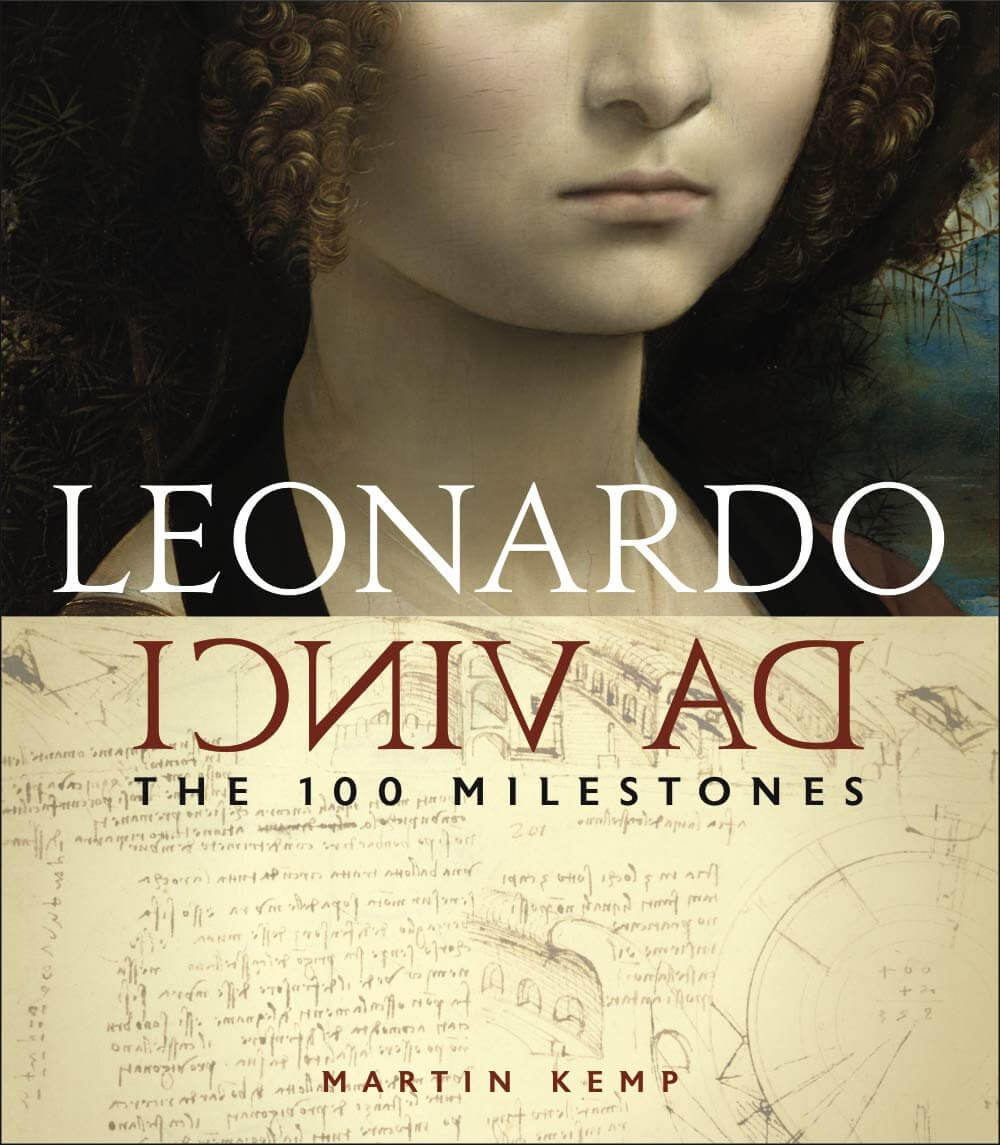
| Author | Martin Kemp |
| Publisher | Sterling |
| Pages | 224 |
| Dimensions | ~10 x 9.1 inches |
| Coverage | 100 works across painting, anatomy, engineering, architecture, science |
| Best For | The best gift under $40; readers who want the whole range, briefly |
Martin Kemp is Emeritus Research Professor in the History of Art at Oxford and has been writing about Leonardo for fifty years, which is why he can get away with a format that would be gimmicky from anyone else. The book selects 100 broadly chronological milestones spanning painting, anatomical study, engineering, architecture and Leonardo's engagement with optics, dynamics, statics, geology and mathematics — one image, one page of Kemp, and on to the next.
The constraint is what makes it good. Kemp has roughly 300 words per entry and no room for hedging, so each one has to identify the single thing that matters about the object in front of you. The selection runs from the paintings to the anatomical studies, engineering drawings and flying-machine designs, and reading it front to back gives you something the big monographs actually obscure: a sense of sequence, of one preoccupation feeding the next across fifty years. It's also the most giftable book here — substantial enough to feel like a real present, cheap enough to buy on impulse, and comprehensible to someone with no art background.
What I keep returning to: The entry on the gearing drawings. Kemp points out that Leonardo drew mechanisms in exploded view — components separated in space to show how they fit — centuries before that became standard engineering practice. One sentence, and you never look at those sheets the same way again.
The honest downside: One hundred entries at one page each means nothing is explored in depth; this is breadth by design. The reproductions are good but modest in scale, and readers who already know Leonardo well will find little here they haven't met before.
The bottom line: The best Leonardo gift book under $40, and the best starting point for anyone who isn't already committed. Not the book for a reader who already owns two others on this list.
7. Leonardo. The Complete Paintings (45th Ed.) — Frank Zöllner
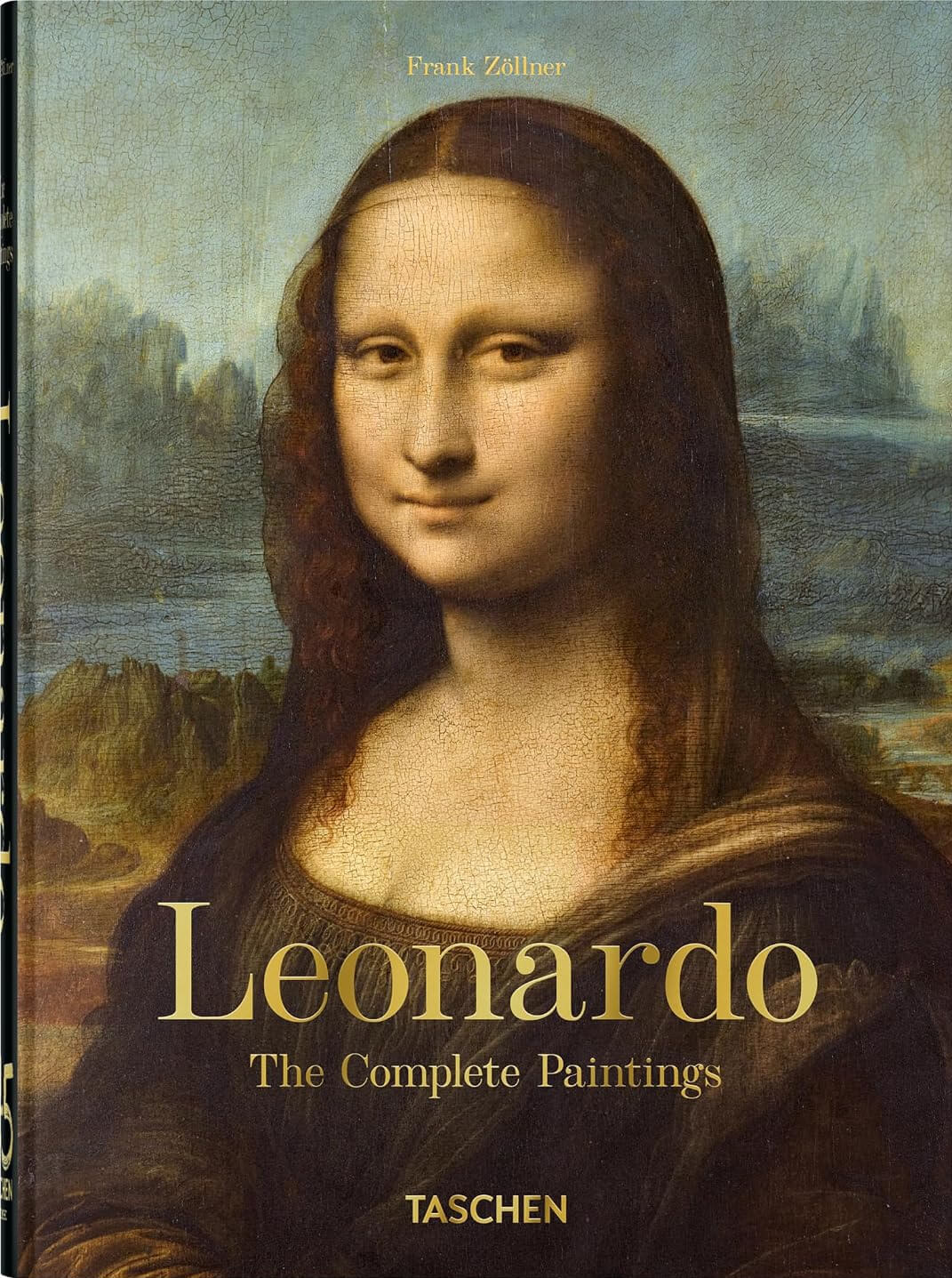
| Author | Frank Zöllner |
| Publisher | Taschen |
| Coverage | Compact catalogue raisonné of all known paintings, in ten chapters |
| Price | Around $30 |
| Best For | Best budget pick; the XXL's scholarship at a tenth of the price and weight |
Taschen's compact Leonardo is the same scholarship as the XXL monograph in a form you can hold in one hand. It's a condensed catalogue raisonné of all the known paintings, drawn from the XXL edition, tracing the life and work across ten chapters using Leonardo's letters, contracts, diary entries and writings, and it costs around twenty-five dollars. Taschen positions it as the companion to their Leonardo graphic-work volume, which together cover paintings and drawings for well under fifty dollars.
The honest framing is that this is a reference book with good pictures rather than a coffee table book. It won't anchor a room and it won't impress anyone across a table. What it will do is answer questions — dating, attribution, condition, provenance — for the price of two coffees, which makes it the right second purchase for anyone who bought a beautiful Leonardo book and then discovered they wanted the facts too.
What I keep returning to: The catalogue entries on the lost works. The Battle of Anghiari, the Leda, the Sforza horse — paintings and sculptures that existed and don't now, reconstructed from copies, contracts and descriptions. Zöllner writes about them with the same rigour as the survivors, and the effect is a quiet reminder of how much of Leonardo we're missing.
The honest downside: Small format, paintings only, and no drawings to speak of. If you want a book that looks like something on a table, this is not it — this is the one that lives on the shelf and gets pulled down.
The bottom line: The best twenty-five dollars you can spend on Leonardo. Not a display book, but the most useful one here per dollar.
8. Leonardo da Vinci Rediscovered — Carmen C. Bambach
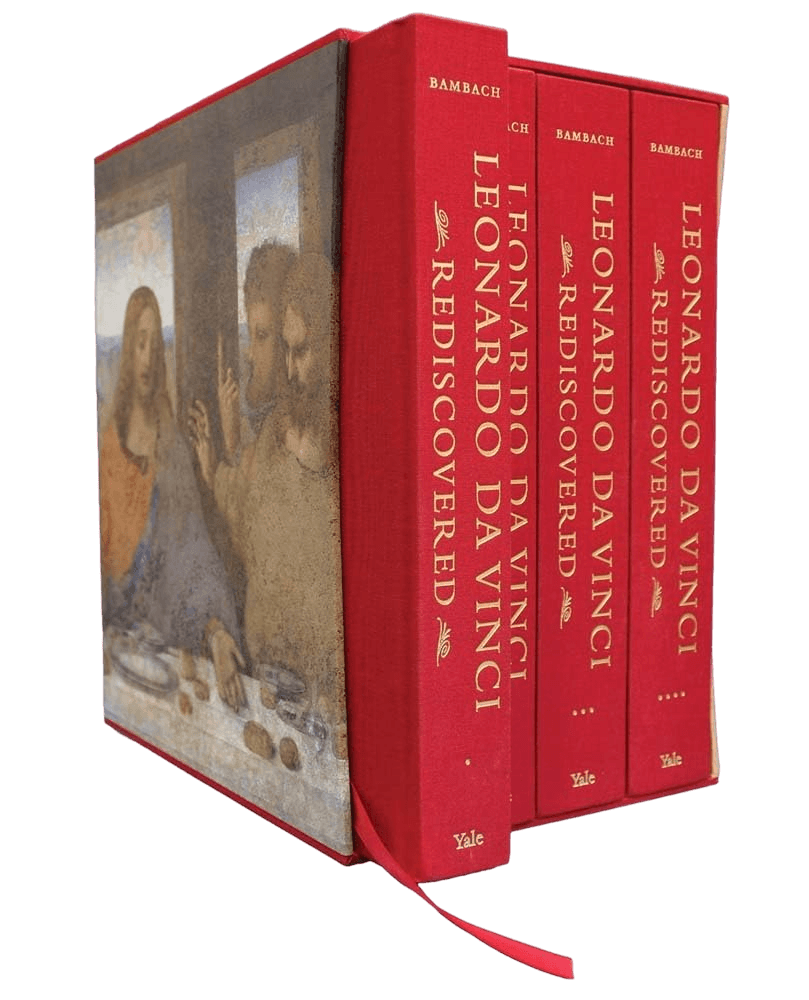
| Author | Carmen C. Bambach |
| Publisher | Yale University Press |
| Volumes | 4 |
| Pages | ~2,200 |
| Coverage | Complete career, ~1,500 illustrations, built outward from the drawings |
| Price | $550 |
| Best For | Serious collectors and anyone who wants the deepest account in existence |
Carmen Bambach is a curator at the Metropolitan Museum of Art and spent roughly a quarter of a century on this. The result is four volumes, some 2,200 pages and around 1,500 illustrations, built on an unusual premise: that the way to understand Leonardo is through the drawings and manuscripts rather than the small body of finished paintings. Bambach works through contemporary documents and more than 4,000 surviving sheets of notes and drawings, in the manner of a biographer rather than a cataloguer.
The Financial Times named it among its books of the year in 2019, and the Art Newspaper described the four volumes as functioning, in effect, as a catalogue raisonné. That's the right frame for a buyer: this is the deepest and most current account of Leonardo available in any language, and it is also a set of scholarly volumes that happen to be beautifully produced, not a book designed for browsing. Reviews at publication were not uniformly adulatory — the set was received to mixed reviews — and the criticism generally concerned scale and organisation rather than scholarship.
What I keep returning to: Volume 1 on the Verrocchio workshop years. Bambach reconstructs what it meant to be a teenage apprentice in a Florentine studio in the 1460s — what you ground, what you were allowed to touch, whose hand did what on a shared panel — and the genius stops being a phenomenon and becomes someone who learned a trade.
The honest downside: $550, four volumes, and 2,200 pages of art-historical argument. This is not a coffee table book and pretending otherwise would be dishonest: nobody flips through it after dinner. It's also physically demanding to shelve and awkward to consult. If you want spectacle, the Taschen XXL delivers far more of it for less than half the price.
The bottom line: The deepest Leonardo in print, for the reader who has already exhausted the others. Buy it as a library, not as an object.
Which Taschen Leonardo Is Which?
Taschen publishes four Leonardo titles with very similar names, and buying the wrong one is the single most common mistake people make in this category — most often ordering what they think is the eighteen-pound XXL and receiving a compact hardcover. Here's what actually differs.
| Title | Format | Contents | Roughly |
|---|---|---|---|
| Leonardo. The Complete Paintings and Drawings (XXL) | 11.4 x 15.6 in, 712 pp, 18 lbs | All paintings + ~700 drawings + catalogue raisonné | $200 |
| Leonardo. The Complete Paintings and Drawings (2-volume midsize) | Midsize, two volumes | Same content, smaller reproductions | Mid range |
| Leonardo. The Complete Paintings (40th Ed.) | Compact hardcover | Paintings and catalogue raisonné only | ~$25 |
| Leonardo. The Complete Drawings / The Graphic Work (Bibliotheca Universalis) | Compact hardcover | Drawings only | ~$25 |
The rule of thumb: if the listing doesn't say XXL and doesn't quote a shipping weight in double digits, it isn't the big one. Check the ISBN before ordering — the current XXL edition is 978-3-8365-8597-2.
How to Choose the Right Leonardo da Vinci Coffee Table Book
If you want the definitive book and have the table for it: Leonardo. The Complete Paintings and Drawings (Taschen XXL). Nothing else reproduces the paintings at this scale.
If you want the best book at a sane price: Leonardo da Vinci: A Life in Drawing. Two hundred sheets from Windsor, expertly chosen and expertly captioned.
If the notebooks are what fascinate you: Leonardo's Notebooks (Suh). His writing and drawing kept together, sorted so you can actually navigate it.
If you come from medicine or science: Leonardo da Vinci: Anatomist. Ninety studies with an anatomist explaining what he got right and what he didn't.
If you want an object rather than a book: The Codex Leicester facsimile. Unreadable, beautiful, and the most talked-about thing you can put on a table for $33.
If you're buying a gift and don't know their level: The 100 Milestones (Kemp). Broad, authoritative, under $40, and it works for a complete beginner.
If you want the facts and don't need the spectacle: Leonardo. The Complete Paintings, 40th Ed. (Taschen). The scholarship at shelf size.
If you already own three of the above: Leonardo da Vinci Rediscovered (Bambach). Twenty-five years of work, four volumes, and nowhere left to go after it.
For the wider Renaissance context these books sit in, our Italy coffee table books guide covers the country that produced him, and our Frida Kahlo roundup applies the same approach to a very different artist. If you're buying as a gift, our coffee table books for men guide places the Taschen XXL alongside other statement-piece options.
Frequently Asked Questions
What is the best Leonardo da Vinci coffee table book?
Leonardo. The Complete Paintings and Drawings from Taschen is the best overall Leonardo da Vinci coffee table book. The XXL edition runs 712 pages at 11.4 by 15.6 inches and includes every known painting, a catalogue raisonné and nearly 700 drawings, reproduced with full-bleed details that show individual brushstrokes. It costs around $200 and weighs just over eighteen pounds.
Which Taschen Leonardo book is the big one?
The large-format edition is titled Leonardo. The Complete Paintings and Drawings and is marked XXL, with ISBN 978-3-8365-8597-2. Taschen also publishes a two-volume midsize version of the same content, a compact paintings-only edition around $25, and a compact drawings volume — all with similar titles. If a listing doesn't say XXL or quote a double-digit shipping weight, it isn't the large-format book.
Is there a good Leonardo da Vinci book under $50?
Yes — three of them. Leonardo's Notebooks (Black Dog & Leventhal) is a large-format volume of his writings and drawings sorted by subject for around $30. Leonardo da Vinci: The 100 Milestones by Martin Kemp covers his full range in 224 pages for under $40. And Volume I of Oxford's Codex Leicester edition is a full facsimile of the notebook Bill Gates owns, published at $32.95.
What's the difference between Leonardo's paintings and drawings books?
Leonardo left fewer than twenty widely accepted paintings but thousands of drawings, so paintings-focused books are necessarily short on material and lean on enlargement and catalogue detail, while drawings books cover far more ground — anatomy, botany, engineering, cartography. If you're drawn to the Mona Lisa and the Last Supper, choose a paintings book. If you're drawn to how his mind worked, choose the drawings or the notebooks.
Are Leonardo notebook facsimiles worth buying?
For most readers, an edited selection like Leonardo's Notebooks is more useful than a facsimile, because facsimiles reproduce the mirror writing without transcription or translation. The Codex Leicester facsimile is the exception worth owning — it's a complete single notebook at near-original scale, and it functions as a display object rather than a reading edition.
How I Sourced This Roundup
Every book in this list was selected on four criteria: reproduction quality, the authority of the person who made it, whether it covers a distinct part of Leonardo's output rather than duplicating another title, and whether it's actually purchasable in 2026. Specifications — page counts, dimensions, weights, prices and edition details — were verified against publisher listings from Taschen, Royal Collection Trust, Oxford University Press, Yale University Press and Sterling, rather than retailer copy, which is where most of the edition confusion on this subject originates. Where a title has multiple editions in circulation, I've said so.